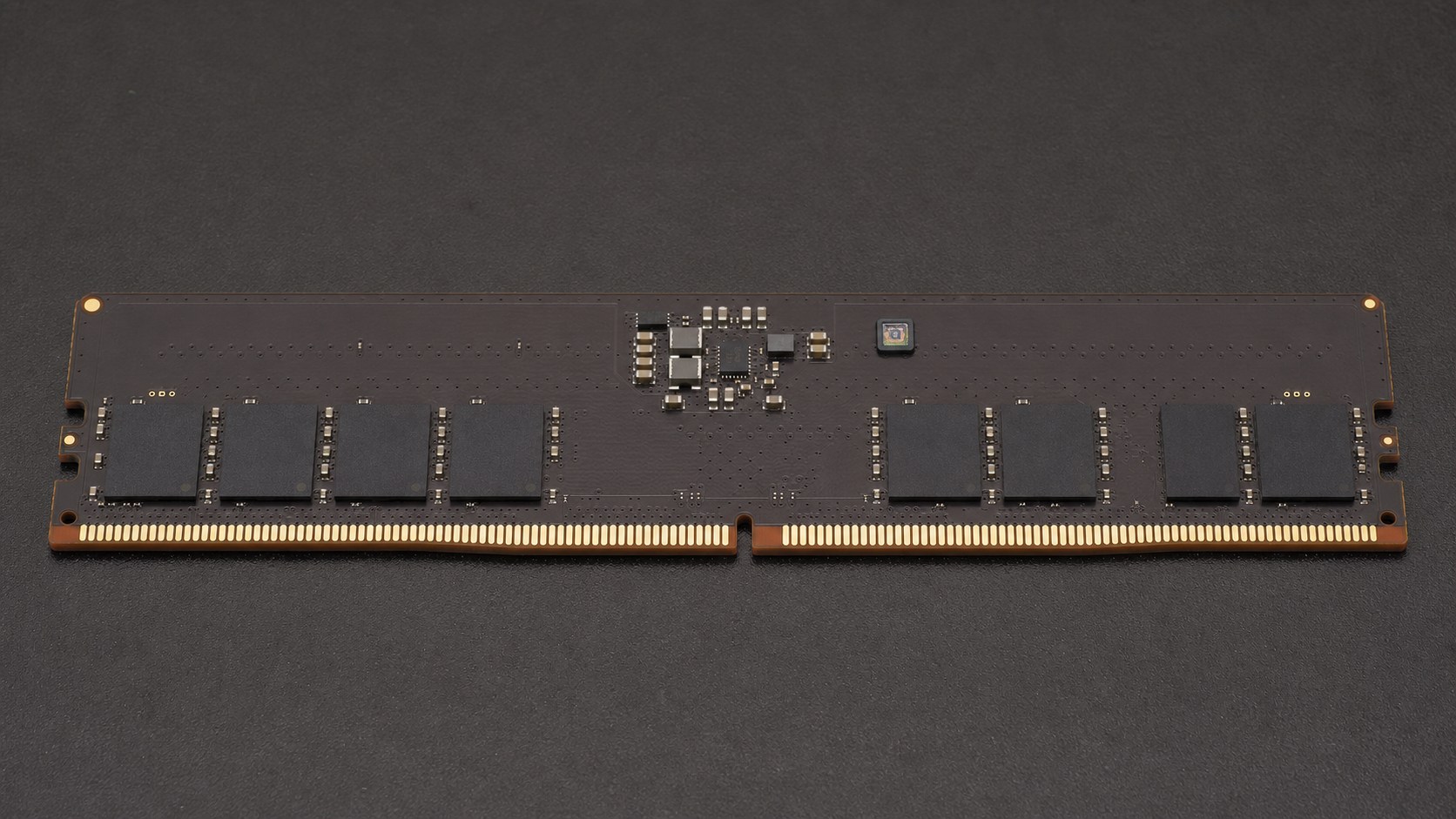
A confidential AI accelerator architecture in a standard DDR5 DIMM. Encrypted models and private data compute inside trusted silicon and never exist in plaintext on the host.
D3 / silicon photonicsDie-to-die and stick-to-stick fabric
0encoder mismatches / ZCU106
0 / 256SDK outputs differ
51 / 51self-checking RTL tests
150 MHzZCU106 timing closed
Exactanalog MAC / SPICE only
0x10 / silicon roles
Register map 01 Architecture target
Three dies. One sealed address space.
This is a logical architecture diagram, not decorative PCB artwork. Select a die to inspect its role. Protected inter-die traffic, final packaging and DDR5 interoperability remain product targets.
Security boundary:Host traffic is sealed today on FPGA. Protected RRAM and photonic inter-die links are a product-silicon target.
0x20 / program selector
Register map 02 Keys 1–5
Five jobs. One resident machine.
Load a workload to reconfigure the instrument. The participating dies, evidence maturity, buyer and hard boundary change with each program.
Program 01 / core
Confidential inference
Regulated-data inference, model-IP protection on untrusted infrastructure and multi-tenant serving with tenant-bound keys. The encrypted datapath and secure loader run on physical FPGA hardware.
D1 digitalD2 RRAMD3 photon
EvidenceDatapath + sealing on ZCU106
BuyersHealth / finance / government / defense
BoundaryPlaintext stays off the host
Boundary: final inter-die protection, capacity, energy and performance await product silicon.
Program 02 / beachhead volume
Embedding, RAG, retrieval
Sentence embeddings and indexed retrieval run beside resident models and sealed corpora. This is the high-volume entry workload: retrieval at memory bandwidth without repeatedly moving the model.
D1 digitalD2 RRAMD3 photon
EvidenceRetriever path proven
Modeled capacity~96–224M indexed tokens / stick
BuyersRAG and search platforms
Boundary: indexed-token capacity, throughput and module energy are first-order product estimates.
Program 03 / sealed adaptation
Private training ladder
LoRA, forward-only MeZO, distilled small-model training and continued pretraining are runnable in the pre-silicon stack and sealed to the tenant key.
D1 digitalD2 RRAMD3 photon
Small models~1.4–1.6× ideal backprop benchmark
Continued pretraining~1.2× ideal adaptation + retention
Hard stopNever frontier pretraining
Boundary: implemented in RTL/software experiments; not measured on a product module.
Program 04 / memory half
Frontier pipeline roles
Sealed rollout, teacher and synthetic-data fleets, RETRO-style retrieval appliances and sparse memory layers. dm3m supplies resident memory work around frontier training. It is not the dense training engine.
D1 digitalD2 RRAMD3 photon
Rollout model~50K tok/s at ~208 W / server
Energy model33–133× below specified baseline
First evidenceSparse memory layer implemented
Boundary: token rate, H100 comparisons and multi-stick scale are modeled and need a published methodology.
Program 05 / non-volatile role
Persistent memory
Non-volatile banks double as storage-class memory over the product DDR5 surface, preserving sealed master state, models, adapters and private corpora through power cycles.
D1 digitalD2 RRAMD3 photon
StateMaster banks non-volatile / no refresh
InterfaceDDR5 form factor + runtime target
BehaviorInstant-on master state
Boundary: persistence semantics, endurance, power-fail behavior and host interoperability are product targets.
keyboard program loader / 1 2 3 4 5
0x30 / private learning
Register map 03 Implemented pre-silicon
A ladder, not a training supercomputer.
The architecture climbs from adapter tuning to continued pretraining, then stops explicitly before frontier pretraining. All stages below are pre-silicon implementations, not product-module measurements.
01
LoRA fine-tune
Few-step tenant-specific adapter adaptation.
Implemented
02
MeZO full-rank
Forward passes only, zero backward graph, inference-level memory.
Implemented
03
Small models from scratch
Private embedders and classifiers through distillation.
Implemented
04
Continued pretraining
Domain adaptation on a sealed private corpus with replay against forgetting.
Training machinery:stochastic rounding / error-feedback masters / transpose-free DFA / replay / deferred NVM write-back: 20 commits per 2,000 steps.
0x40 / evidence register
Register map 04 No maturity laundering
Proof has an address.
Filter the ledger by maturity. FPGA hardware, RTL/software implementation, SPICE verification, first-order modeling and product targets never share the same label.
Bit-identical twin; local sparse zero-transpose gradients.
Device-honest INT8 experiments
Implemented
40.0B
Tiled matmul
Integer tiling path for models larger than one local array.
Pre-silicon compute stack
Implemented
40.0C
Precision + generation
INT4 / INT8 / INT16 bit-serial precision per layer; decoder and KV-cache path.
Product architecture
Target
40.0D
Module envelope
~12–15 W active; ~0.3 W idle for non-volatile master state.
First-order thermal / power model
Modeled
40.0E
Product module
eMRAM/RRAM dies, silicon-photonic links and DDR5 interoperability.
Next milestone: process test chip
In development
FPGAPhysical programmable silicon
RTLImplemented / pre-product
SPICECircuit experiment only
MODELFirst-order estimate
TARGETProduct not yet built
0x50 / slot sequencer
Register map 05 Modeled scaling view
Turn memory slots into a sealed fabric.
Move the control to explore a linear first-order scaling model. These are architecture estimates, not measured DIMM or server results.
Product projection hidden. The proof register at 0x40 remains visible; disable evidence-only mode to restore scaling estimates.
16-slot sequencer
Every illuminated register is one modeled dm3m DIMM. The product target uses standard DDR5 slots; no CXL or add-in-card variant.
dm3m target
Resident-weight private inference, retrieval, adaptation and persistent memory. Local analog-array efficiency target: 40–80 TOPS/W; the 700-TOPS / 208-W server model is ~3.4 delivered TOPS/W after system scope. Procurement thesis: reduce dependence on HBM and advanced GPU packaging by moving weights into a standard-slot memory architecture; availability remains time-sensitive and modeled.
H100 comparison boundary
H100 supports confidential computing. dm3m instead targets plaintext confined to trusted die domains and resident weights in memory slots. A 16-DIMM configuration is compared with a one-H100 deployment assumption; energy, token rate and availability remain modeled. NVIDIA H100 reference.
Positioning:~30–130× modeled energy/token on memory-bound inference; ~10× modeled batched rollout throughput in the specified comparison. Not a raw-FLOPS replacement for dense generation or frontier pretraining.
0x60 / buyer matrix
Register map 06 Market routing
Who buys which address.
The cells show direct product fit. “Role” means a pipeline component, not the primary compute engine.
Buyer / workload
01 / private inference
02 / retrieval
03 / adaptation
04 / frontier memory
05 / persistent
Regulated industries
·
·
AI vendors / model owners
·
·
RAG / search platforms
·
·
·
Frontier labs
·
·
Sovereign / air-gapped
·
0x70 / product path
Register map 07 Public program gates
From working digital path to product silicon.
The current proof reduces digital architecture risk. It does not remove foundry, device, package, optical, DDR5 compliance or product-security work. Specific foundry, process and program economics are shared only during qualified diligence.
Stage 00 / complete
FPGA foundation
Confidential encoder, secure loader, live transport, bit-exact SDK, tests and timing closure.
PROVEN
Stage 10 / next
Process test chip
Map the digital path; characterize eMRAM, RRAM, PPA and mixed-signal behavior.
DESIGN + TEST
Stage 20 / product
Qualified module
Packaging, photonic fabric, protected links, DDR5 interoperability, reliability and compliance.
VALIDATE + QUALIFY
Stage 30 / scale
Build or license
Finished modules or licensed silicon/system IP.
COMMERCIAL PATH
Status / read before using numbers
Digital confidential-CIM and the bit-exact software path are proven on FPGA hardware. Training and memory-layer machinery is implemented pre-silicon. Analog MAC evidence is SPICE-only. Power, capacity, TOPS, token rate, H100 comparisons and availability are first-order estimates. Final eMRAM/RRAM arrays, protected inter-die links, silicon photonics, DDR5 interoperability and storage-class behavior are in development.
Design partners / regulated data / proprietary models
Trust you can install.
Provable private inference in the servers you already own, at the energy cost of memory instead of moving the model through a separate accelerator hierarchy.